Introduction
The National Identity Card (CNIC) is one of the most important documents for every citizen of Pakistan. It is not only an official proof of identity but is also mandatory for accessing several government and private services. Be it opening a bank account, getting a passport, buying a mobile SIM, voting or applying for a government scheme — a valid CNIC is required everywhere.
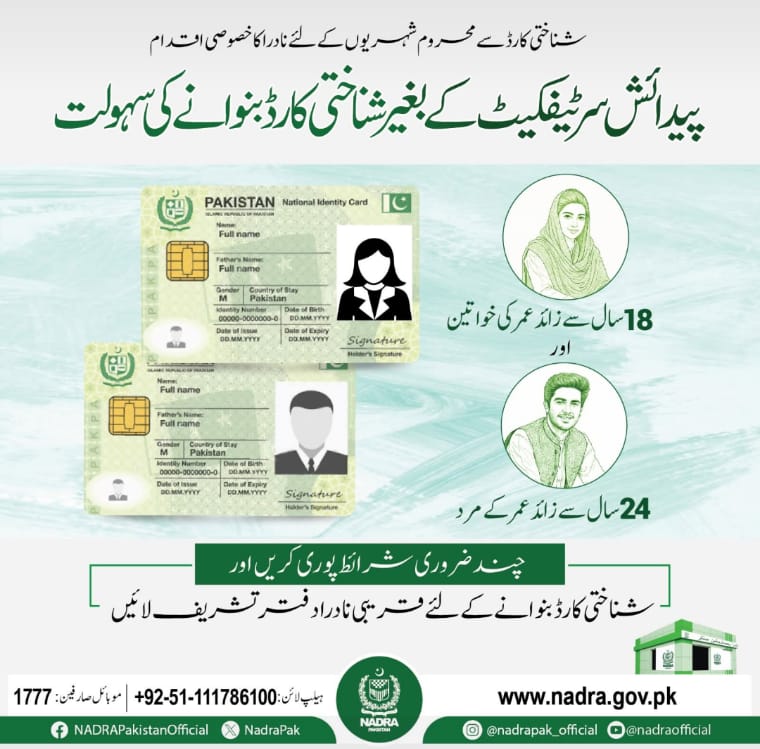
Although Pakistan’s national identification system is quite robust and extensive, there are still some individuals who have not been able to obtain their CNIC till now. The main reason for this is the lack of a birth certificate. This problem is especially prevalent among women and residents of remote or backward areas where formal registration could not be done at the time of birth. To address this long-standing issue, NADRA (National Database and Registration Authority has announced a special facility aimed at including the remaining individuals in the national identification system.
But still, about 1.7 percent of adults are without an identity card. The main reason for this gap is the lack of a birth certificate, which is issued by the local government. Without this document, many citizens will not be able to fulfill the traditional requirements for an identity card.
Keeping in mind the same issue, NADRA has announced a special facility aimed at including the remaining individuals in the national identification system. This initiative provides a one-time opportunity for those who were unable to apply earlier due to documentary issues.
Duration of this special facility
NADRA has clarified that this facility is for a limited period and will be available until December 31, 2026. This means that eligible citizens have a specific time during which they can apply under relaxed documentary conditions.
This facility is especially for those individuals who want to get an identity card for the first time.
If a citizen does not have a birth certificate issued by the local government So NADRA accepts the following alternative documents:
- Pre-registered family ID cards
- Parents’ CNIC or NICOP
- Husband’s CNIC or NICOP for married women
- Valid marriage certificate
These documents will be accepted conditionally. The identity of the applicant will be verified through biometric verification (fingerprints) and NADRA’s existing family records to maintain transparency and security of the system.
Separate conditions for women and men
Keeping in mind the social and documentary issues, NADRA has set some specific conditions for women and men.
Women aged 18 years and above
Such women will have to provide the following documents:
- If married, valid marriage certificate
- CNIC or NICOP of either parent
- Biometric verification of father or husband
This facility is especially beneficial for women who were not registered at the time of birth.
Required documents and application procedure are given below
Applicants can apply for CNIC through the following methods:
- Direct visit to NADRA Registration Center
- Online application through Pak ID app
Required documents may include:
- CNIC/NICOP of parents or spouse
- Family registration record
- Valid Nikah Nama (if applicable)
- Biometric verification (fingerprints)
Fingerprints will be taken during the application and the information provided will be matched with NADRA records. After complete verification, the CNIC will be issued.
Benefits of this initiative
This special facility is especially beneficial for those who were so far outside the CNIC system.
Inclusion in the National System
People without birth certificates will now be able to formally become part of the National Identification System, which will increase data accuracy and national inclusion.
Access to important services
Citizens can avail the following facilities through the CNIC
- All information provided is correct and truthful Do
- Complete biometric verification
- Submit application before 31st December 2026
- Legal action may be taken if false or fake information is provided.